

You’ve sent the invites, booked the flights, and committed to saying “I do” somewhere spectacular, the last thing you want is for friends and family to grumble that they’ve spent time and money attending a wedding abroad that turns out not to be the “real” one, with a second “official” ceremony planned back in England and Wales.
The good news is that, with the right preparation, your overseas wedding can take place at the chosen destination and be fully recognised at home, saving you the cost, stress, and awkward explanations that come with having two ceremonies, one at home and one abroad.
By front-loading the effort and making sure you follow the correct legal steps, you can be confident that your destination wedding is the real deal.
In practical terms, if you intend to marry in Italy, it all comes down to three things:
- Your circumstances
- Providing the correct documents
- Local Municipality approval
Who Can Marry – Circumstances
Italy does not impose residency requirements on foreign couples. However, both parties must:
- Be at least 18 years old
- Not be currently married or in a civil partnership
- Not be closely related by blood or adoption
- Have the mental capacity to consent to marriage
Where at least one spouse holds legal residency in Italy, the marriage is subject to the banns process (pubblicazioni di matrimonio), irrespective of either party’s nationality.
In practice:
- The banns are posted at the Comune of whichever spouse is resident in Italy — this applies equally to Italian citizens residing in Italy
- They remain published for 8 days, after which a further 3-day waiting period must elapse
- Once both periods have passed, the marriage may proceed
Types of Ceremony
Civil Ceremony
A civil ceremony is conducted at the local town hall (Comune) by an authorised registrar. This is the most straightforward route for foreign nationals and will be automatically recognised in England and Wales, provided it complies with Italian law. You must visit the Comune before the ceremony to make a formal declaration of intent to marry – typically a few days in advance. Requirements vary slightly between municipalities, so confirm the process with your specific Comune early. A list of the communes can be found here.
Catholic Religious Ceremony
A Catholic ceremony carries full legal effect in Italy if conducted according to canon law requirements. At least one partner must be Catholic. You will need to provide:
- Baptism and First Communion certificates from your parish
- A Pre-Cana marriage preparation certificate
- Permission letters from your bishop and local priest, as you are marrying outside your home parish
- Written diocesan approval if entering a mixed-religion marriage
Same-Sex Couples
Italy does not permit same-sex marriage, but since 2016 has legally recognised same-sex civil unions (unioni civili). The requirements broadly mirror those for opposite-sex marriage including the need for a nulla osta from each party’s consulate, a declaration before the registrar at any Comune, and the presence of two witnesses, with one notable difference: civil unions are not subject to the banns (pubblicazioni di matrimonio) process, making the procedure somewhat simpler.
A same-sex civil union lawfully celebrated in Italy is recognised in England and Wales, provided it complies with Italian law and each party had the legal capacity to enter into it. The same rules apply in relation to matrimonial property regimes and any marriage contracts (convenzioni patrimoniali).
Required Documents
All foreign documents must be legalised with an Apostille stamp and accompanied by a certified Italian translation – without these steps, the marriage cannot be legally registered in Italy. The core documents for British nationals are:
- Valid passport – both parties; must remain in date and not due to expire within 6 months of marriage date.
- Full birth certificate – the long-form version; short versions are not accepted
- Certificate of No Impediment (CNI) – must be apostilled and translated (see below)
- Statutory declaration / Atto Notorio – confirms you are free to marry
- Decree absolute or death certificate – required if either party has been previously married
- Evidence of name change – deed poll or statutory declaration if your name has changed
Names must match exactly. Discrepancies between names on different documents are one of the most common causes of delays and invalid registrations. Every document must show your name identically as it appears on your passport.
The Certificate of No Impediment (CNI)
The CNI is the most important document in the process for UK nationals. It confirms there is no legal obstacle to your marriage under English law. The steps are:
- Give notice at a UK register office. Both parties must attend in person. A minimum 28-day notice period applies before the CNI can be issued.
- Receive the CNI. Valid for 6 months if issued in England or Wales, or 3 months if issued in Scotland.
- Obtain an Apostille via the Foreign, Commonwealth & Development Office (FCDO). Allow extra time for this step.
- Arrange a certified Italian translation. Confirm with your Comune whether a sworn translator is required.
Allow 6–10 weeks for the full CNI process. The notice period, issuance, apostille, and translation together take longer than most couples anticipate – and the CNI has a validity window of 180 days, so timing matters.
Do You Need an Interpreter?
Civil ceremonies in Italy are conducted in Italian. If neither party speaks Italian, or if the officiating registrar requires it, an interpreter may need to be present. Requirements vary between municipalities:
- Some Comuni require a sworn interpreter to be present and to countersign documents
- Others will accept a bilingual witness or allow the ceremony to proceed with informal translation
Confirm the interpreter requirement directly with your chosen Comune well in advance.
Local Municipality Approval Must be Obtained in Advance
Before the ceremony, you must submit your intention to marry – and all required documents – to the local Comune where the ceremony will take place. The municipality will check that you meet all legal requirements. Only once the Comune accepts your documents and issues approval can the ceremony be legally conducted.
This advance approval is required for both civil and religious ceremonies.
Recognition of Italian Marriages in England and Wales
A marriage conducted in Italy in compliance with Italian law is automatically recognised in England and Wales. You do not need to register it at a UK register office or take any formal steps to have it recognised. Your Italian marriage certificate (certificato di matrimonio) is your proof of marriage.
It is advisable to obtain several certified copies of the Italian marriage certificate before leaving Italy, as obtaining them remotely can be time-consuming. The certificate should be translated and apostilled for the purposes of immigration, banking, or legal proceedings.
Practical Steps to Ensure a Smooth Marriage Process
- Start 4–6 months before your marriage date – the documentation process is lengthy and delays are common
- Contact your chosen Comune early – confirm exactly what they require and in what format, as requirements vary between municipalities
- Check all names match exactly – review every document before submitting; even minor discrepancies can invalidate the registration
- Give notice for your CNI – allow for the 28-day notice period plus apostille and translation time
- Apostille and translate all foreign documents – every document must be legalised and certified into Italian before submission
- Arrive in Italy with time to spare – you must attend the Comune in advance to complete the declaration of intent
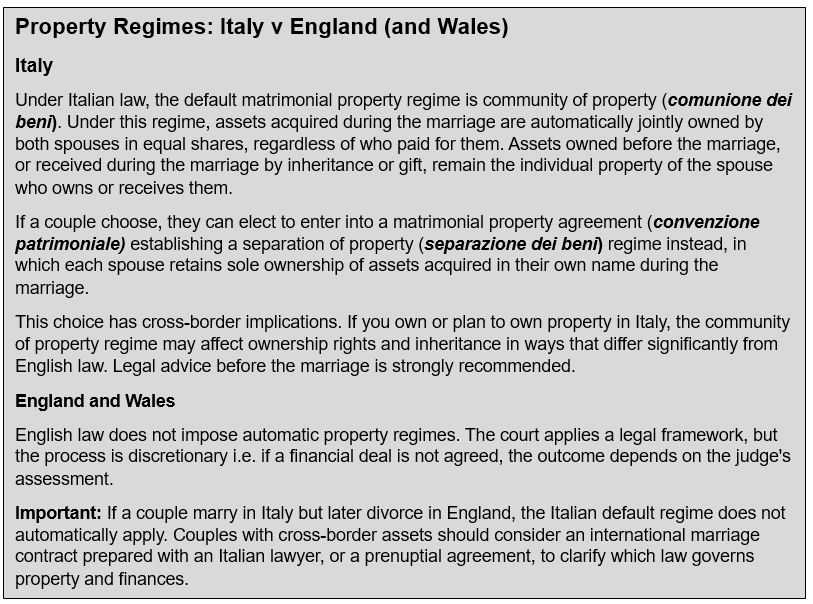
- Decide on your marital property regime – if you hold or plan to hold Italian assets, take legal advice before defaulting to community of property
- Check interpreter requirements with your Comune – confirm whether a sworn interpreter must be present at the ceremony
- Address inheritance and succession planning – review your will, consider a cross-border pre-nuptial agreement, and take advice on applicable EU succession regulations if you hold Italian assets
- Collect your Italian marriage certificate – obtain several certified copies before leaving Italy
- Update your UK records after returning home – update your passport, HMRC records, driving licence, financial accounts, and legal documents as needed
Key Takeaways
- Marriage in Italy is legally recognised as valid in England and Wales if it complies with Italian law and is properly registered.
- Apostilled documentation and certified Italian translations are essential – if in doubt, contact the local Comune, explain your circumstances, and make enquiries directly.
- Property regimes differ between Italy and England and Wales, and contracts and pre-nuptial agreements can help avoid disputes.
- The marital property regime election is made at the time of marriage and is difficult to change – take legal advice before the day.
This article is for general information only and does not constitute legal advice. The authors are not specialists in Italian marital law. Readers should always seek independent legal advice from a qualified Italian legal professional as required.