

You’ve sent the invites, booked the flights, and committed to saying “I do” somewhere spectacular – the last thing you want is for friends and family to grumble that they’ve spent time and money attending a wedding abroad that turns out not to be the “real” one, with a second “official” ceremony planned back in England and Wales.
The good news is that, with the right preparation, your overseas wedding can take place in Spain and be fully recognised at home, saving you the cost, stress, and awkward explanations that come with having two ceremonies, one at home and one abroad.
The not-so-good news is that Spain is one of the more restrictive European destinations for foreign couples, particularly where a civil ceremony is concerned. By front-loading the effort, understanding the residency position, and following the correct legal steps, you can still be confident that your destination wedding is the real deal.
In practical terms, if you intend to marry in Spain, it all comes down to three things:
- Your circumstances (in particular, residency)
- Providing the correct documents
- Local Civil Registry or Church approval
Who Can Marry – Circumstances
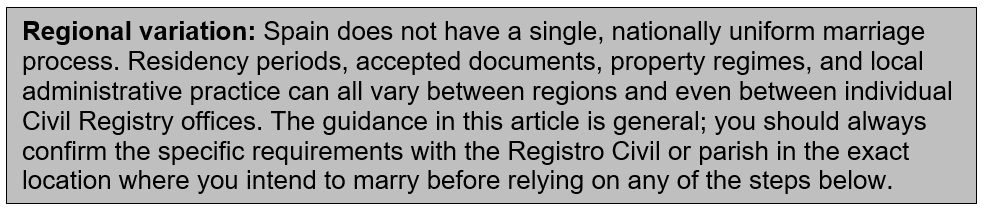
This is the single most important point for couples planning to marry in Spain: for a civil ceremony, at least one party must either be a Spanish national or have been legally resident in Spain for a qualifying period (commonly two years, though this varies by region and by Civil Registry office). If neither party is a Spanish national or resident, a civil marriage in mainland Spain will generally not be available to you.
This residency requirement is the key practical difference from many other popular wedding destinations, and it often catches couples out. It should be checked and addressed at the earliest planning stage, before venues, suppliers, or guests are booked.
Aside from the residency position, both parties must also:
- Be at least 18 years old
- Not be currently married or in a civil partnership
- Not be closely related by blood or adoption
- Have the mental capacity to consent to marriage
Types of Ceremony
Civil Ceremony (Registro Civil)
A civil ceremony in Spain is conducted at the local Civil Registry (Registro Civil) or town hall (ayuntamiento). As set out above, one of the couple must be a Spanish national or have established residency in the relevant municipality, usually for a continuous period of around two years, although requirements vary between regions and individual registry offices. For most English/Welsh couples planning a destination wedding without an existing residency connection to Spain, a civil ceremony is therefore likely to be unavailable.
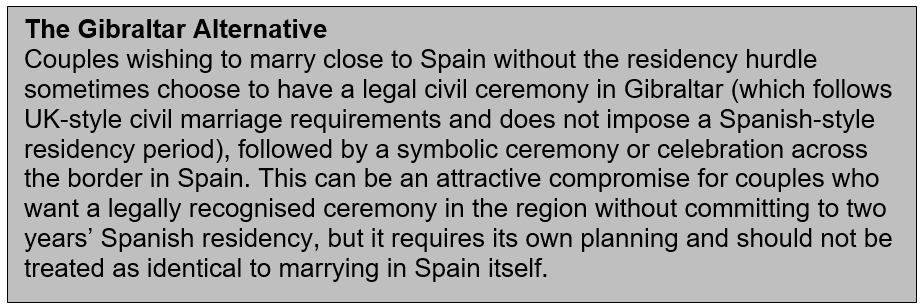
Some couples resolve this by holding a legal civil ceremony in the UK before travelling, and treating the Spanish ceremony as the celebratory event, with no separate legal status. This is a common and pragmatic solution, but it means the “real” wedding, legally speaking, takes place at home rather than in Spain.
Catholic Ceremony
A Catholic wedding in Spain is recognised as legally valid without the residency requirement that applies to civil ceremonies. This makes it the principal route for non-resident couples who want their Spanish wedding to be the legally recognised ceremony.
To marry in a Catholic church in Spain you will need to liaise directly with the parish, usually well in advance (six months is often recommended), and provide supporting documents including baptism certificates, a certificate of confirmation, and a letter from your home parish priest confirming you have completed any pre-marital course requirements and are free to marry. Following the ceremony, the marriage documents must be lodged with the local Civil Registry, usually within a short period (commonly one week), in order to be formally registered under Spanish law.
Other Religious Ceremonies
Spain also recognises marriages conducted under certain other religious frameworks (including some Protestant, Jewish, and Islamic ceremonies) where the relevant religious body has a formal cooperation agreement with the Spanish state, but the position varies and should be checked directly with the relevant religious authority and the local Civil Registry, as not every denomination or location will qualify.
Symbolic or Blessing Ceremonies
Many couples without residency or a qualifying religious connection choose a symbolic or blessing ceremony in Spain, on the beach, in a vineyard, or at a private venue, alongside a separate legal civil ceremony in England and Wales, either before or after travelling. The Spanish ceremony in this scenario has no independent legal effect, and it is the English/Welsh ceremony that is legally determinative.
Same-Sex Couples
Spain has permitted same-sex marriage since 2005 and treats same-sex and opposite-sex couples identically under Spanish marriage law. The same residency requirement for civil ceremonies, and the same Catholic Church position (the Catholic Church does not conduct same-sex religious marriages), apply equally.
A same-sex civil marriage validly conducted in Spain (where the residency requirement is met) will be recognised as a marriage in England and Wales in the same way as an opposite-sex marriage.
Required Documents
All foreign documents must be apostilled and accompanied by a certified Spanish translation – without these steps, the marriage cannot be legally registered. The core documents for British nationals are:
- Valid passport – both parties
- Full birth certificate – the long-form version, apostilled and translated; some registries require this to be recently issued (commonly within the last 3–6 months)
- Certificate of No Impediment (CNI) – obtained from a UK register office and then exchanged for a local Spanish CNI, or applied for directly through the British Consulate-General in Spain (see below)
- Marital Status Certificate (MSC) – required by some Civil Registry offices, particularly in Barcelona, in addition to or instead of a CNI
- Decree absolute or death certificate – required if either party has been previously married
- Proof of residency – for civil ceremonies, evidence of Spanish nationality or qualifying residency (such as a certificado de empadronamiento)
- Religious documents – for a Catholic ceremony, baptism and confirmation certificates and a letter of freedom to marry from your home parish
Names must match exactly. Discrepancies between names on different documents are one of the most common causes of delays and invalid registrations. Every document must show your name identically as it appears on your passport.
Requirements vary by region and by the individual Civil Registry office or parish, so it is essential to contact the specific Registro Civil or church where you intend to marry to confirm exactly what they require, in what format, and by what date.
The Certificate of No Impediment (CNI) and Marital Status Certificate (MSC)
Since 3 February 2025, the British Consulate-General in Madrid only accepts online applications for the CNI and MSC; paper applications are no longer processed. The routes available are:
- Exchange a UK CNI for a local CNI. If you live in the UK, give notice and obtain a CNI from a UK register office first, then apply online to exchange it for a local CNI, as Spanish authorities will only accept a CNI issued in Spain.
- Apply for a CNI by post (online application) from the embassy. If you live abroad, or you travel to Spain without a UK CNI, you can apply for a CNI directly through the British Consulate.
- Apply for an MSC. Required by some registries, particularly the Central Civil Registry in Barcelona; can be applied for alongside a CNI in a single application if both are needed.
The required forms to apply for a CNI or MSC can be found here-Spain: certificate of no impediment and marital status certificate application packs – GOV.UK
All forms (MSC affirmation, CNI affirmation, and notice of marriage, as applicable) must be notarised separately by a notary in Spain before submission.
Allow 8–12 weeks for the full process. The UK notice period, exchange process, apostille, translation, and notarisation in Spain together take longer than most couples anticipate, particularly given the additional residency documentation required for civil ceremonies.
Do You Need an Interpreter?
Civil and religious ceremonies in Spain are conducted in Spanish (or, in some regions, a regional language such as Catalan). If neither party speaks Spanish, an interpreter may be required:
- Some Civil Registry offices require a sworn (jurado) interpreter to be present and to countersign documents
- Catholic parishes will often allow a bilingual family member or friend to translate informally, but this should be confirmed with the priest in advance
- All written documents submitted to the Civil Registry must be translated by a sworn translator, regardless of whether an interpreter attends the ceremony itself
Confirm interpreter requirements directly with your chosen Civil Registry office or parish well in advance. Many couples use a Spain-based wedding planner experienced in legal weddings, who can assist with interpretation and liaison.
Civil Registry or Church Approval Must be Obtained in Advance
Before the ceremony, you must submit your documents – including your CNI and/or MSC, birth certificates, and proof of residency where applicable – to the local Registro Civil for review(a full list of the civil registries can be found here). The registry will check that you meet all legal requirements, including the residency condition for civil ceremonies, before the ceremony can proceed.
For a Catholic ceremony, the equivalent approval sits with the parish priest, who will confirm the couple’s eligibility to marry in the Catholic Church and ensure the necessary pre-marital documentation and courses have been completed before the wedding date.
Given the regional variation in Spanish marriage administration, confirm the exact process, required documents, and submission deadlines with your chosen registry office or parish as early as possible.
Recognition of Spanish Marriages in England and Wales
A marriage conducted in Spain in compliance with Spanish law (whether a qualifying civil ceremony or a Catholic ceremony properly registered with the Civil Registry) is automatically recognised in England and Wales. You do not need to register it at an English/Welsh registry office or take any formal steps to have it recognised. Your Spanish marriage certificate is your proof of marriage.
It is advisable to obtain several certified copies of the Spanish marriage certificate (certificado literal de matrimonio) before leaving Spain, as obtaining them remotely can be time-consuming. For use in immigration, banking, or legal proceedings in England and Wales, the certificate should be translated into English and apostilled.
Note: a symbolic or blessing ceremony conducted in Spain, with no underlying civil or qualifying religious registration, has no legal effect and will not be recognised as a marriage in England and Wales. In that scenario, it is the separate English/Welsh ceremony (if one takes place) that is the legally recognised marriage.
Practical Steps to Ensure a Smooth Marriage Process
- Start 6–12 months before your marriage date – the documentation and residency position make this one of the slower destinations to plan
- Establish whether a civil ceremony is realistically available to you – check the residency requirement with the specific Registro Civil where you intend to marry; if neither party qualifies, plan for a Catholic ceremony, an English/Welsh civil ceremony with a Spanish celebration, or the Gibraltar route instead
- Contact the Civil Registry or parish early – confirm exactly what they require and in what format, as requirements vary significantly by region and even by individual office
- Check all names match exactly – review every document before submitting; even minor discrepancies can invalidate the registration
- Apply online for your CNI and/or MSC – remember that paper applications are no longer accepted by the British Consulate-General in Madrid, and allow extra time for exchange, notarisation, and translation
- Apostille and translate all foreign documents – every document must be legalised and certified into Spanish before submission
- Have each form notarised separately in Spain – MSC affirmation, CNI affirmation, and notice of marriage forms each require individual notarisation
- Confirm interpreter requirements – check with the registry office or parish whether a sworn interpreter must be present at the ceremony
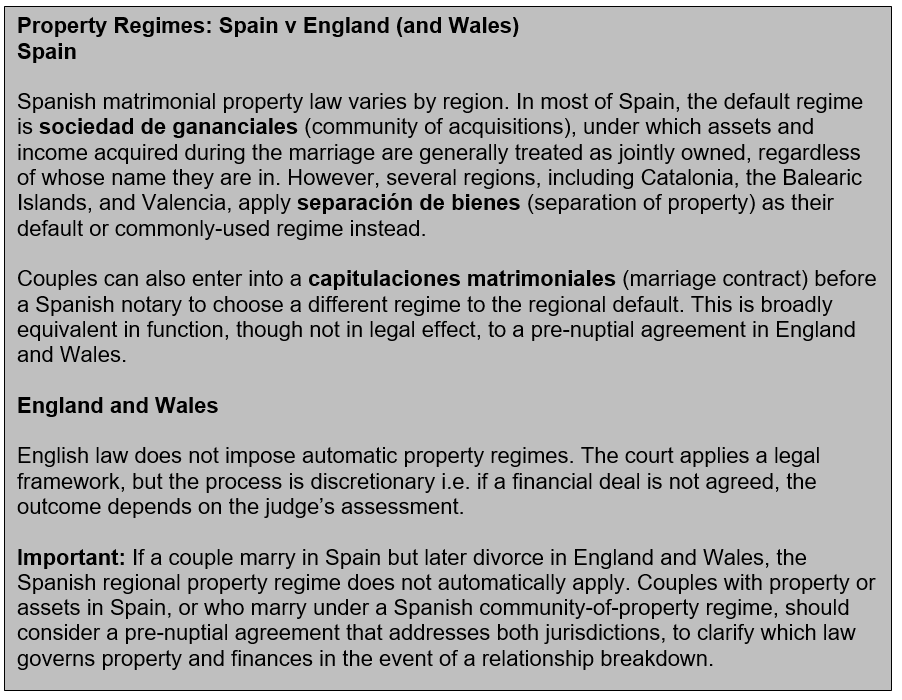
- Decide on your approach to property and finances – take advice on the applicable Spanish regional property regime and consider a marriage contract or pre-nuptial agreement covering both jurisdictions
- Collect your Spanish marriage certificate – obtain several certified copies before leaving Spain
- Update your UK records after returning home – update your passport, HMRC records, driving licence, financial accounts, and legal documents as needed
Key Takeaways
- Marriage in Spain is legally recognised in England and Wales if it complies with Spanish law, but a civil ceremony generally requires one party to be a Spanish national or established resident – check this first.
- A Catholic ceremony, properly registered with the Civil Registry, is the main route to a legally recognised marriage in Spain for non-resident couples.
- Since February 2025, CNI and MSC applications to the British Consulate-General in Madrid must be made online; paper applications are no longer accepted.
- Apostilled documentation and certified Spanish translations are essential – if in doubt, contact the local Registro Civil or the British Consulate directly.
- Spanish regional property regimes vary; take specialist advice if you hold or plan to hold assets in Spain.
This article is for general information only and does not constitute legal advice. The authors are not specialists in Spanish marital law. Readers should always seek independent legal advice from a qualified Spanish legal professional as required.