

For separated or divorced parents, the start of a new academic year can bring more than just timetables
and uniform lists… it can raise difficult questions about who pays for private school fees and how those costs should be shared.
In terms of VAT on nursery fees, provided the class is “wholly (or almost wholly) of children under compulsory school age and would not be expected to attain that age while in that class” nursery fees are not subject to VAT. Nursery schools not attached to private schools remain exempt, regardless of the age of the children.
The Court’s Approach
The courts generally seek to maintain continuity and stability in a child’s education, but the ability to do so depends heavily on affordability and fairness between parents. School fees (including nursery fees) fall within the assessment of a child’s “needs,” but how they are treated depends on whether the case is dealt with under the Matrimonial Causes Act 1973 (MCA 1973), or the Children Act 1989 (CA 1989).
Matrimonial Causes Act 1973 (MCA 1973)
This applies where parents are or were married. Subject to jurisdiction issues, the court can order periodical payments for a child. When deciding what financial provision is fair the court must consider a range of factors (set out in the MCA 1973).
The court will assess “needs” holistically, considering the needs of the children, along with that of both spouses.
Educational expenses such as school fees form part of this assessment of needs, but are discretionary, not automatic.
In practice:
- the court will aim to preserve a child’s existing education if it is affordable.
- orders for private school fees will not be made if they cause undue hardship to the paying parent.
- the issue is considered as part of the wider financial settlement.
Children Act 1989 (CA 1989)
This applies predominantly where parents are unmarried or when child-related financial provision is sought outside financial proceedings related to divorce.
Under Schedule 1, the court can order periodical payments, lump sums, or property settlements for the benefit of a child.
The child’s welfare is paramount. Under the CA 1989, the court’s focus is narrower. The judge will consider the child’s specific educational and welfare needs, and not fairness between adults.
Relevant factors include each parent’s income, financial responsibilities, and the manner in which the child was being or expected to be educated.
In practice:
- private school fees are often treated as a specific educational need.
- courts try to preserve the child’s educational stability if this is financially realistic.
- the paying parent’s means remain a central consideration.
The Court’s Jurisdiction
The Child Maintenance Service (CMS) deals with child maintenance where the paying parent’s income is below £156,000 gross per year. Where income exceeds £156,000, the non-paying parent can apply to the court for a “top-up” order and/or for a “school fees” order.
Under the Child Support Act 1991, the CMS formula determines maintenance based primarily on the non-resident parent’s income. But the CMS does not have jurisdiction over private or independent school fees (including nursery fees) and the court retains jurisdiction to make orders for private education costs, even where CMS maintenance is in place.
However, such an order must be separate and justified, based on:
- the child’s existing educational arrangement.
- the financial resources of each parent.
- the reasonableness of continuing private education.
The guiding principle remains the child’s welfare balanced against the payer’s means.
When a parent applies to court it must ensure that there is no double counting, i.e., that a parent isn’t paying for the same element of maintenance twice, once via CMS, and once via court order.
How the Court Avoids Double Counting
The CMS maintenance formula assumes that the non-resident parent:
- Pays maintenance out of gross income, before tax;
- But the recipient receives the full amount tax-free.
So, when a court orders the parent to pay extra costs directly (like private school fees), those payments are made net of tax, but still reduce the parent’s disposable income in real (post-tax) terms.
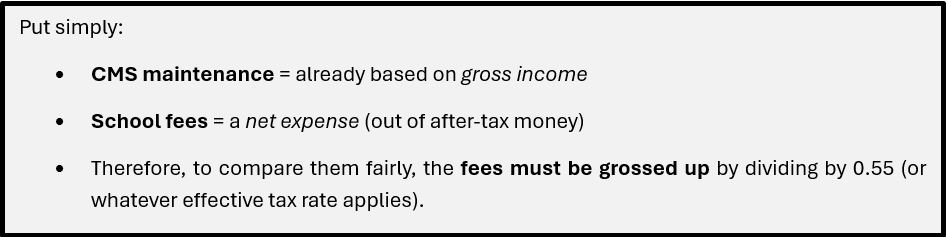
To compare “like with like”, i.e., CMS payments (gross-based) with school fees (net)-the fees must be “grossed up” to reflect their gross income equivalent.
Roughly speaking:
- A high earner (above £100,000) currently pays about 45% in combined tax plus National Insurance.
- This means £1 of net spending (like paying school fees) requires about £1 ÷ 0.55 ≈ £1.82 of gross income.
So, when the court assesses affordability and fairness (within the CMS-based system),
the school fees should be “grossed up” to reflect that£1 in school fees actually costs £1.82 in gross terms.
In practice, if a CMS calculation has been made, school fees can either:
- be funded from that maintenance (if both parents agree), or
- a separate application can be made for either a ‘top up’ child maintenance and/or a school fees order which would factor in any CMS calculation adjusting the formula as needed to avoid double counting.
N.B., parents should be aware that a CMS calculation may not be necessary. Subject to the facts of the case, it does not necessarily need to be the ‘first step’ in assessing and calculating child maintenance, and the absence of a calculation (even a ‘maximum’ calculation) will not prevent the court from making an order.
Practical Guidance – Top Tips for Parents
- Assess affordability realistically. School fees are discretionary, and courts will not make unaffordable orders.
- Negotiate early. Address school fees as part of any financial settlement, particularly in light of the change in VAT rules.
- Take advice promptly. If you or your partner are considering private education for children post-separation taking early legal advice can help ensure that school fee commitments are structured appropriately, whether through court orders or private agreements.
- Focus on the child’s welfare. Courts will prioritise the child’s educational stability and welfare above all else.
Private school fees can become one of the most emotionally charged and financially complex issues following separation. With VAT changes and rising costs, early advice is more important than ever.
If you are negotiating fees or considering a top-up order, take specialist guidance before making commitments – the right approach can protect both your child’s education and your financial stability.
For an initial FREE consultation on any aspect of family law, call Manders Law on 01245 895 105 or email us here.
Note: this blog is intended to give an overview (rather than comprehensive guidance and advice) on your legal or financial position and is provided for information only. It is not an endorsement of any product or service provider.