

Let’s be honest: getting married abroad isn’t just about romance and sunsets – it’s also about fewer guests, better photos, and the quiet hope that your uncle who always tells embarrassing stories will get lost somewhere between the airport and the venue. You’ve agonised over the dress, colour-coded the napkins, and debated table plans like they are a matter of national importance. Every detail is flawless. Yet many couples treat the legal side of getting married abroad as an afterthought.
If this feels all too familiar do not fear – this guide explains what you need to know before getting married abroad, and when legal advice may be essential.
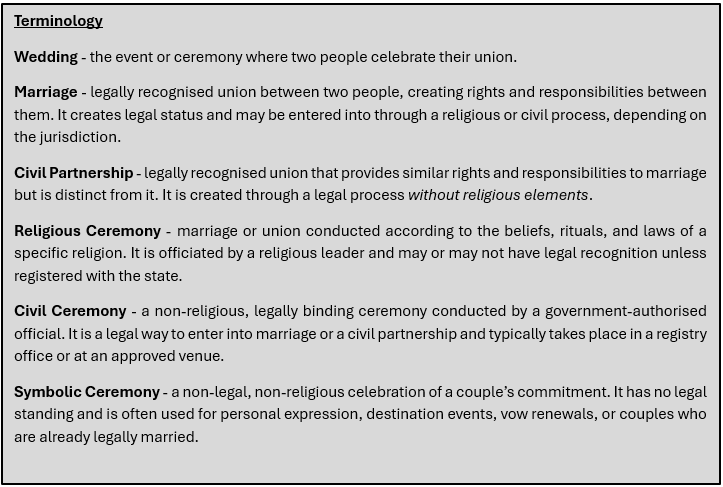
Am I legally married if I have my wedding abroad?
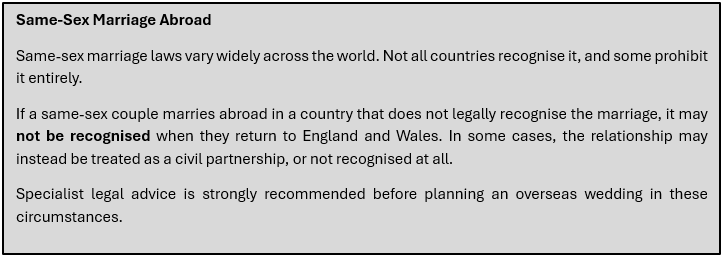
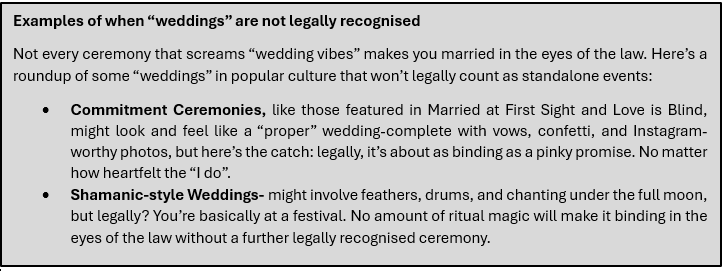
Overseas weddings raise important legal and financial considerations. Couples are frequently surprised to discover that not all overseas weddings are automatically recognised in England and Wales. Common misconceptions are divided between two camps:
- all overseas weddings are automatically recognised in England and Wales
- You must have a civil ceremony in England and Wales before (or after) you have your “wedding” abroad to make it legal.
The truth lies somewhere in the middle. In many cases, a wedding that takes place abroad will be a legally recognised marriage or civil partnership in England and Wales, provided that:
- The marriage/civil partnership is valid under the law of the country where it took place
- Both parties have the legal capacity to marry/enter into a partnership (for example, meeting age and consent requirements)
- The correct legal formalities are followed
If these conditions are met, the marriage will be treated as legally valid in England and Wales.
Legal Formalities: Why Local Law Matters
Every country has its own marriage laws, and these can differ significantly from those in England and Wales. Common requirements by local authorities may include:
- Birth certificates and passports
- Evidence of marital status (such as a certificate of no impediment)
- Residency requirements (for example in France, at least one of the parties, or a parent of a party, must have been resident in the commune for least 40 days prior to the marriage)
- Translations of any documents into the native language of the destination using a professional translation service –Find a Certified Translator
- Legalised documents (see process outlined below)
- Attendance at a civil registry office
Failing to follow the local legal process precisely may result in a ceremony that is symbolic only, with no legal effect.
A common misconception is that both religious and civil ceremonies abroad will automatically create legally valid marriages. In reality:
- Some religious ceremonies are legally recognised in certain countries
- Others have no legal status unless accompanied by a civil ceremony
This means that even if a wedding feels “official” and all the relevant documents have been provided it may not be legally binding at all. This can cause serious difficulties later, particularly if issues arise relating to divorce, inheritance, immigration or pensions.
I know what I need to do and what I need to provide; do I need to do anything with the documents?
Depending on the country, you may be asked for one or more documents to be notarised or apostilled. You should check with the local authority as to your intended destination’s requirements.
A document is notarised when it has been officially certified by a Notary Public. See Find a Notary .
This means the notary has:
- Verified who you are (checked your ID)
- Witnessed your signature or confirmed a copy is a true copy of the original
- Applied their official signature, stamp, or seal
A document is apostilled when it has been legalised for international use by a government authority.
In the UK, this is carried out by the Foreign, Commonwealth & Development Office (FCDO).
An apostille:
- Confirms that the notary or official who signed the document is legitimate
- Then a apostille certificate is attached (usually a stamped page)
An apostille confirms the notarisation or official signature is recognised by foreign authorities.

Risks involved with getting married abroad
If your marriage is not legally valid and recognised under the law of England and Wales issues can arise in relation to:
- “Divorce”. If you are not legally married it follows that you cannot get divorced. Currently, there is no automatic legal protection or status for cohabiting couples in England and Wales. This means that even if you have been living as a “married” couple you may not be provided with any financial protection on the breakdown of your relationship.
- Immigration. Where one partner is not a British citizen, the validity of an overseas marriage will be closely examined by the UK Home Office, to ensure that visas are not obtained fraudulently. Any uncertainty around the legality of the ceremony or documentation can result in delays or refusals for entry.
Even is your marriage is legally recognised there are still important considerations to bear in mind:
- Finances and Property Regimes. Couples are often unaware that marrying abroad may automatically subject them to foreign matrimonial property regimes, unless steps to avoid this are taken in advance.

What can be done to avoid/reduce the risks?
To avoid the above risks, it is vital to:
- speak to the local authority in the country in which you intend to marry to confirm all legal formalities have been met and you have all the required documents
- Organise for professional translators at any ceremonies (if required)
- Obtain sufficient information ahead of time in relation to immigration requirements to avoid unnecessary stress and delay
- Obtain legal advice on finances and specifically any country-specific property regimes, to avoid unwittingly signing up to these.
When Should You Speak to a Family Lawyer?
You should consider speaking to a family law solicitor before getting married abroad if:
- You are unsure whether the ceremony will be legally recognised
- One or both of you are from a different country
- You plan to live in England or Wales after the wedding
- There are significant assets or children involved
- You are considering a prenuptial agreement
Early advice can provide clarity, reassurance, and long-term protection.
How We Can Help
We regularly advise clients in England and Wales on the legal implications of overseas marriages. Our services include:
- Advising on whether a marriage abroad will be recognised
- Drafting prenuptial and postnuptial agreements
- Providing ongoing family law advice if circumstances change
This article is for general information purposes only and does not constitute legal advice. Laws relating to international marriage vary by jurisdiction and individual circumstances. Readers should obtain specific legal advice before acting on the information provided.
Country Specific Guidance
For country specific guidance please see our handy guides which provide the basic outline of the requirements and property regimes in these wedding hot spots:
For an initial FREE consultation on any aspect of family law, call Manders Law on 01245 895 105 or email us here.
Note: this blog is intended to give an overview (rather than comprehensive guidance and advice) on your medical, legal or financial position and is provided for information only. It is not an endorsement of any product or service provider.